Physical 2^4 Methods
Thanks to William Jestin Palmer (Hyperespy) for the diagram template!
Notation
Because this is a physical puzzle, we can easily adapt x, y, & z rotations to fit the moves. The puzzle is held horizontally throughout most of the solve, so the L and R cells can do any x, y, & z rotations freely. The I and O cells can do any x rotation, as well as only y2 or z2 rotations. The other sides have restricted turning due to the projection, and can only do 180 degree twists, so they will just be referred to as U2, D2, F2, B2.
Gyro Algorithm

Gyro algorithm
From a solved puzzle, there's nothing you can do to change the orbits of the L/R stickers, so we need an algorithm to do a special 4D rotation of the puzzle, called a gyro.
A commonly used algorithm for the Gyro is:
- Take the left endcap off and put it on the right so it becomes the right endcap (this brings the puzzle into the inverted state)
- Ly Ry'
- Take the right endcap off and put it on the left so it becomes the left endcap (this brings the puzzle back into the normal state)
- Rx2 B2 D2 Lx2
Note that the last 2 moves (D2 Lx2) could be replaced by D2 Rx2, U2 Lx2, or U2 Rx2 based on the solver's preference.
Watch [Melinda's 6 Snap Gyro] for an alternative algorithm.
Orienting Both Cells
Grant's Method

Exactly 8 oriented to the U/D axis

8 on L, 8 on the U/D axis of R
- The first step is to get EXACTLY 8 pieces from an opposite colour group oriented to U/D. They can be in any position, as shown in the diagram, but must be oriented to the U/D axis. Make sure that there are exactly 8, then perform the gyro algorithm
- Use inspection time to count which of the 4 sets of colours have the most oriented to U/D, and start with that set.
- Pair up the other 8 pieces into a cell where they are oriented to U/D. This will end up separating the pieces that you oriented in the first step onto it's own cell
- Rotate the R cell so the pieces are oriented to the I/O axis (a z or z' rotation). Then perform the gyro algorithm
- Undo the last 2 moves of the gyro. Then just undo that Rz or Rz', and do another gyro
- Now you will have all 16 corners oriented to the L/R axis
Rowan's Method
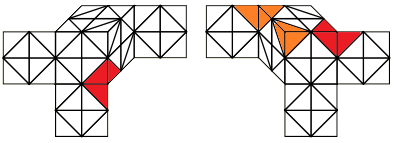
4 or less corners oriented to L/R

12 oriented to U/D
- To start, you want to pick an axis that has 4 or fewer corners oriented to L/R (4 does happen to be the easiest case, but fewer than 4 is fine)
- Use block building or RKT to orient a cell's U/D axis
- Use RKT to build a layer on the opposite cell, orienting 12 corners to U/D
- Do the gyro algorithm to get the 12 corners to the L/R axis
- Setup the 4 (or fewer) corners into one of these OCLL cases (H, Sune/Antisune, U) depending on how many corners you counted at the beginning
- Gyro again, then solve the OCLL case using RKT. (Hint: you can use the [Guimond algorithms] (marked with a G) to save a few moves)
- Once all 16 corners are oriented to U/D, use the gyro algorithm to get them all oriented to L/R
Permuting Both Cells
P4L
Originally developed by Connor Lindsay as PAL (Permuting All Layers), P4L permutes all 4 layers at the same time once they are separated - an exact dimensional analogy of the 2^3 Ortega method.
- Block build a cell whose layers are oriented, but not necessarily permuted correctly
- Use RKT to orient 2 opposite layers of the last cell, just like in the Ortega 2^3 method
- Execute an algorithm to permute all 4 layers at once
-
You can also learn only a handful of algorithms, and learn advanced case manipulation to morph a bad case into a good one. Some cases are the same as 2^3 algs, and other are like domino cube 2^3 algs.
CBC
- Directly solve one of the cells using block building or RKT techniques
- Solve the last cell using RKT
RKT Parity
If you end the solve and a single layer needs twisting by 180 degrees, then do this algorithm with RKT:
There is also [this] video by Melinda with many alternative algorithms.